


In many controlled manufacturing environments, cleaning products have remained largely unchanged for years. A dry wiper and a squeeze bottle of IPA have simply become “the way it’s always been done.”
And in many facilities, that familiarity creates complacency.
But as semiconductor, aerospace, medical device, pharmaceutical, and other advanced manufacturing industries continue pushing toward tighter tolerances and higher performance expectations, manufacturers are beginning to reevaluate every part of the contamination-control process, including cleaning methods that may not have evolved alongside the rest of the operation.
More organizations are recognizing that contamination control is not simply a housekeeping function. It’s a process-control function. And the tools used within that process directly influence consistency, reliability, and operational outcomes.
That shift is changing how facilities clean and why more manufacturers are adopting pre-saturated cleanroom wipers.
Cleaning Consistency Is a Process Variable
Critical manufacturing environments, carefully control nearly every variable that can influence production outcomes, including:
- Equipment calibration
- Material inputs
- Environmental conditions
- Process parameters
- Operator procedures
And cleaning processes should be approached with the same level of discipline.
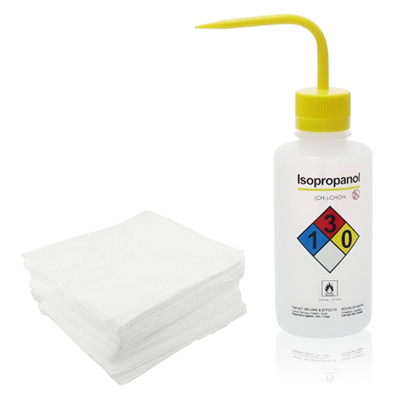 Traditional dry wiper and squeeze bottle techniques can introduce unnecessary variability into contamination-control procedures. Solvent application often differs from operator to operator and even throughout a single shift. Some wipers may be oversaturated, others undersaturated, and human application techniques naturally vary over time.
Those inconsistencies can affect:
- Surface wetting
- Particle removal
- Solvent evaporation rates
- Residue levels
- Cross-contamination risk
Pre-saturated cleanroom wipers help standardize this process by delivering a controlled amount of chemistry in every wipe. Instead of relying on manual saturation, the solvent load is engineered directly into the product, helping create a more repeatable cleaning method across operators and applications.
Saturation Control Matters
Effective cleaning is not simply about applying solvent to a surface. The interaction between the wiper, the chemisty, and the contaminant plays a major role in cleaning performance.
Surface tension influences how evenly solvent spreads, while saturation levels affect how effectively particles are lifted, captured, and retained within the wiper material structure.
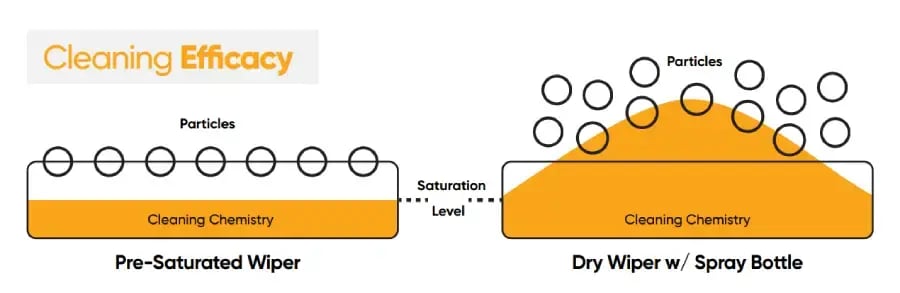
When saturation levels vary, cleaning performance varies as well.
Valutek’s pre-saturated wipers are designed to support a more balanced and controlled cleaning process by helping deliver:
- Uniform surface wetting
- Improved particle capture
- Reduced streaking and residue
- More consistent contaminant removal
- Repeatable cleaning outcomes
As manufacturing processes become increasingly sensitive to microscopic contamination, these details matter more than ever.
Supporting Process Stability
Today’s cleanrooms and controlled manufacturing facilities represent enormous investments in equipment, automation, and process control. In many environments, even small contamination events can have downstream consequences that impact:
- Product yield
- Equipment downtime
- Reliability
- Rework rates
- Product quality
- Compliance performance
Because of this, contamination-control products are increasingly evaluated based on their ability to support operational stability.
Pre-saturated wipers help support that objective by reducing one of the more operator-dependent variables within the cleaning process.
Rather than relying on each individual operator to manually achieve the correct solvent level every time, facilities can implement a more standardized approach that helps reduce process variation and improve repeatability.
Reducing Operator Dependency
Even highly trained operators perform tasks slightly differently under changing workloads and production conditions. Dry wipe systems inherently rely on individual judgment, including:
- How much solvent to apply
- When to reapply solvent
- How wet the wipe should be
- How aggressively to clean
Pre-saturated wipers simplify many of these decisions by standardizing solvent delivery before the wipe ever reaches the cleanroom floor.
That standardization can help support:
- Improved repeatability between operators
- Simplified training
- More consistent SOP execution
- Better documentation practices
- Reduced risk of over- or under-saturation
For tightly controlled manufacturing environments, those advantages can contribute meaningfully to broader contamination-control goals.
Operational and Safety Advantages
In addition to cleaning performance benefits, pre-saturated wipers can also help simplify operational and compliance considerations associated with manual solvent handling.
Depending on the application, this may include:
- Reduced solvent exposure
- Simplified chemical handling procedures
- Lower spill risk
- Improved solvent inventory control
- More consistent labeling practices
- Reduced on-floor IPA storage requirements
These operational efficiencies often become an added benefit alongside process improvements.
From Consumable to Process Tool
As advanced manufacturing environments continue evolving, contamination control is becoming increasingly integrated into broader process optimization strategies.
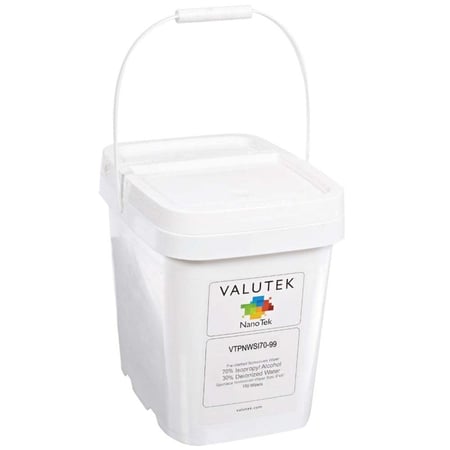 Pre-saturated cleanroom wipers reflect that shift.
Rather than functioning solely as a consumable item, they serve as a process tool designed to help improve repeatability, reduce variation, and support more controlled cleaning outcomes.
At Valutek, that philosophy continues to guide how we approach contamination control solutions, helping customers move beyond legacy cleaning methods toward more consistent and process-driven manufacturing practices.
Because in modern manufacturing, consistency matters at every step of the process.