


Selecting the right cleanroom consumables is about far more than choosing gloves, wipers, or apparel off a shelf. In controlled environments, every product introduced into the cleanroom becomes part of the contamination control strategy. When consumables are mismatched to the process or cleanliness level of the environment, they can quietly undermine process stability, yield, and compliance.
NanoTek, MicroTek, MacroTek – What Do They Mean?
To simplify this decision-making process, Valutek developed a three-tier product classification system: NanoTek, MicroTek, and MacroTek. These classifications group gloves, wipers, apparel, and accessories based on high-level cleanroom application and cleanliness requirements, helping ensure that products used together are compatible with both the environment and each other.
Rather than expecting cleanroom users to interpret raw technical data alone, Valutek’s classification system provides an intuitive framework that aligns consumable selection with cleanroom standards and real-world use cases.
What Is a Cleanroom Classification?
Cleanroom classifications define the maximum allowable concentration of airborne particles in a controlled environment. These particles may include dust, microbes, fibers, aerosols, or other microscopic contaminants that can compromise or interfere with sensitive manufacturing or research processes.
A key principle of cleanroom design is simple: the lower the class number, the cleaner the room.
For example, an ISO Class 3 cleanroom is significantly more controlled than an ISO Class 7 environment and requires tighter control of airflow, filtration, materials, and gowning practices. As cleanliness requirements increase, so does the need for consumables that contribute minimal particle and residue contamination.
This is where consumable selection becomes critical. Not all gloves, wipers, or garments are suitable for all cleanroom classes and processes.
ISO vs. Federal Standard 209E
Two different standards are commonly referenced when discussing cleanroom classifications:
- Federal Standard 209E (legacy U.S. standard)
- ISO 14644-1 (current international standard)
In 2001, ISO 14644-1 formally replaced Federal Standard 209E. Today, ISO 14644 is the globally accepted standard for classifying cleanroom air cleanliness, while 209E terminology still appears in older facilities, specifications, and legacy documentation.
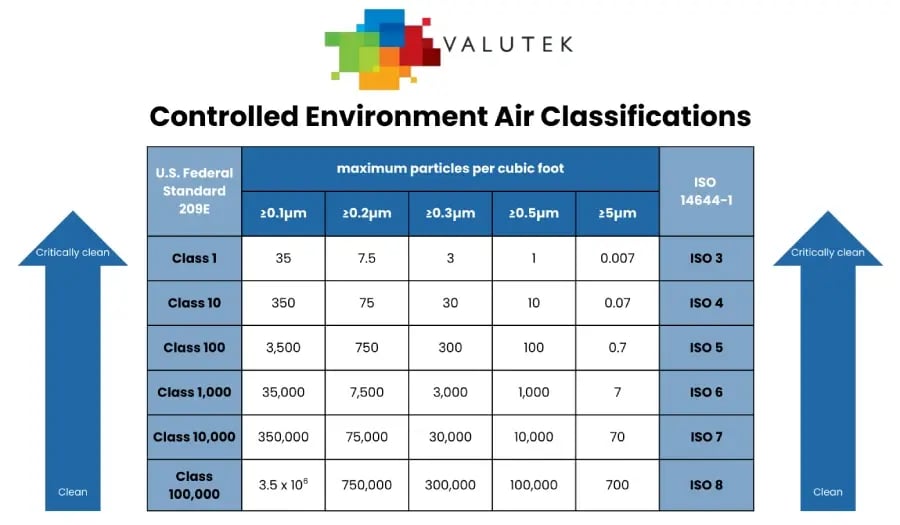
Because many documents still reference both systems interchangeably, Valutek supports both ISO and legacy class terminology within its product classification framework. This allows for easier product selection and matching for existing facility requirements and customer specifications.
Why Product Classification Matters
Using consumables that are misaligned with the cleanroom classification can introduce unnecessary risk. Products that shed particles, fibers, or residues may be acceptable in ISO 7 environments but completely unsuitable for ISO 3 applications.
When consumables are not properly matched to the environment, potential consequences include:
- Increased particle counts
- Higher risk of product defects or contamination
- Process instability and lower yields
- Compliance concerns during audits or inspections
Valutek’s NanoTek, MicroTek, and MacroTek classifications remove ambiguity by aligning consumable performance with cleanroom cleanliness levels and typical process sensitivity.
Valutek Product Classification Overview
- NanoTek – Most Critical Cleanroom Requirements
Designed for ultra-clean environments where even minimal contamination can impact product performance.
Typical applications: ISO Class 3–4 (Class 1–10) - MicroTek – Medium-Level Cleanroom Requirements
Suitable for controlled manufacturing and assembly where moderate particle control is required.
Typical applications: ISO Class 5–6 (Class 100–1,000) - MacroTek – Least Critical Cleanroom Requirements
Intended for support areas, gowning rooms, and less sensitive controlled environments.
Typical applications: ISO Class 7 and higher (Class 10,000+)
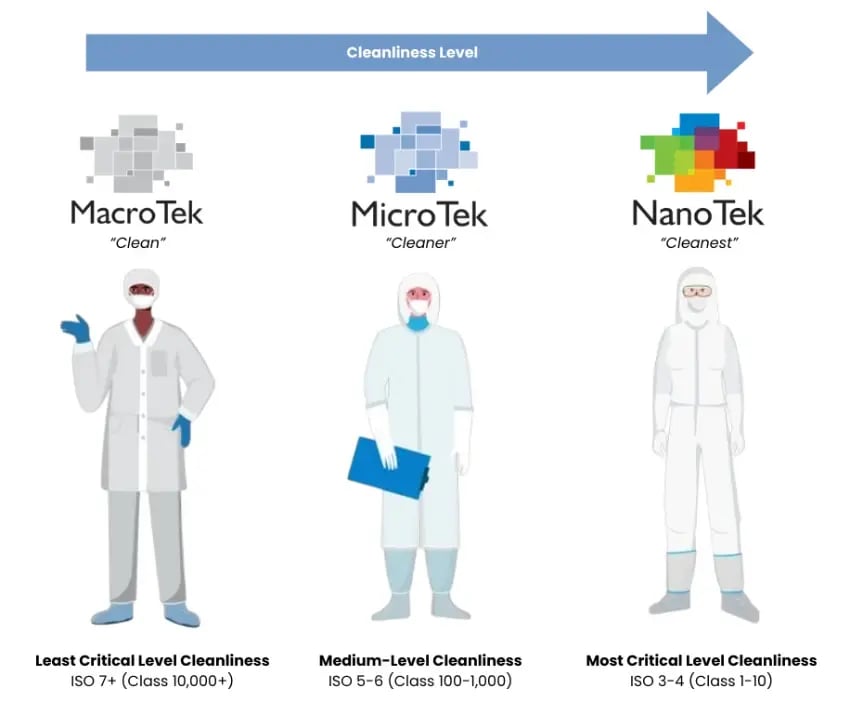
This tiered structure helps quickly narrow down product selection to the appropriate performance level before evaluating additional features and more detailed product features such as material type, physical characteristics, packaging configuration, or cost considerations.
A System Designed for Compatibility
Valutek’s product classification system is designed to support:
- Faster and more confident product selection
- Consistent contamination control across product categories
- Reduced risk of mixing incompatible consumables in the same environment
- Easier specification and ordering
By grouping gloves, wipers, apparel, and accessories into NanoTek, MicroTek, and MacroTek families, anyone can build a more cohesive consumable program that aligns with their cleanroom classification and process sensitivity.
Valutek’s classification system serves as a practical roadmap, and a starting point in helping ensure that the products used in a cleanroom support, rather than compromise, contamination control goals.
Explore More Resources:
-
From Matched Sets to Maximum Cleanliness: Gloves and Wipers in Focus
-
Why Two Cleanroom Standards? Understanding Federal and ISO Standards
-
Cleanroom Glove Selection Fundamentals: What You Need to Know | Part 1
- Product Selection Recommended Practices | Technical Paper Series